
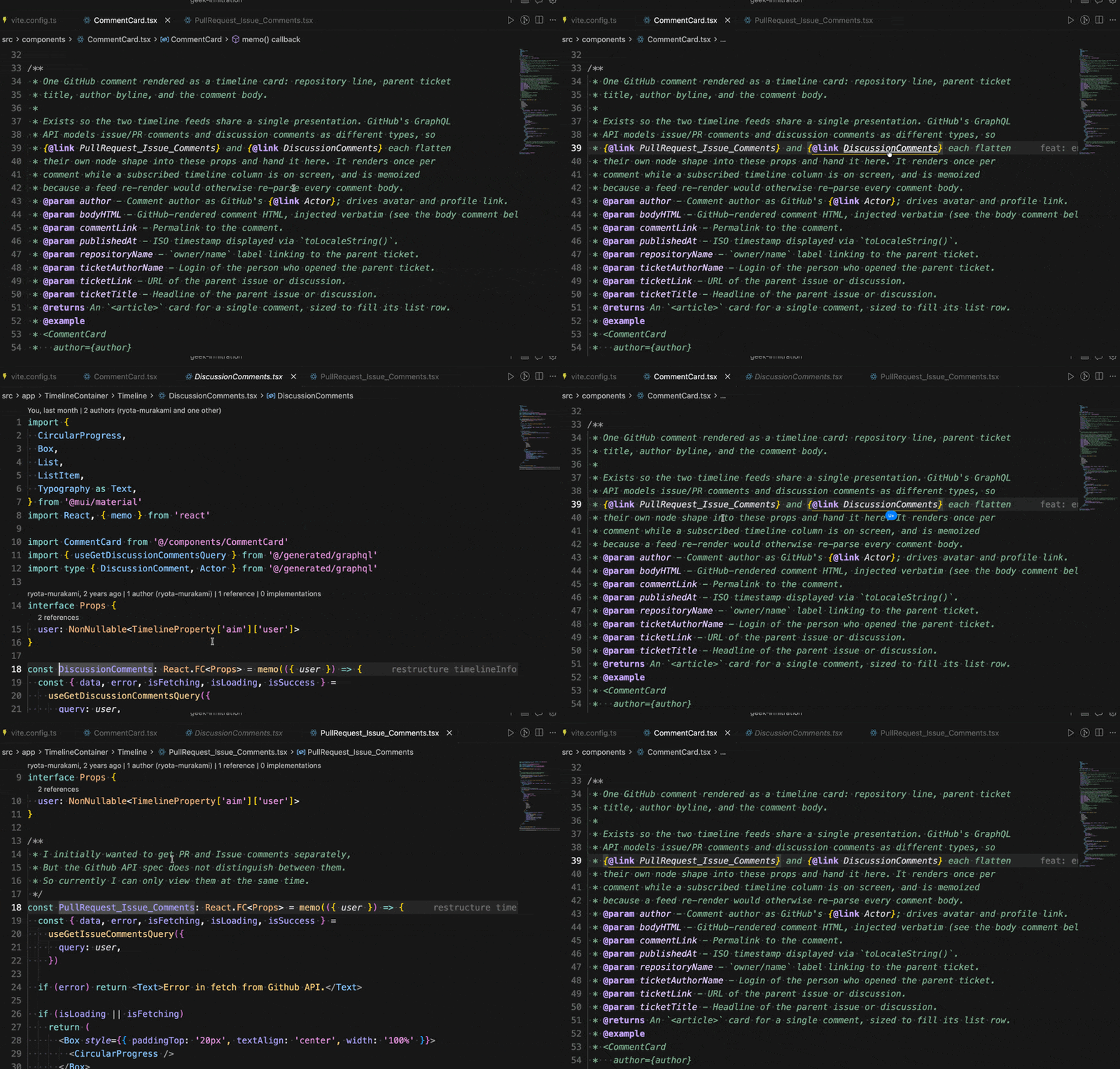
A while ago I released Go To Definition for JSDoc, a small VS Code extension for jumping from {@link} references to workspace symbols. This post is about the part I explained badly the first time — and about what I would like to happen next.
What TypeScript already does
{@link} navigation is not missing from TypeScript. It works right now, with no extension at all, as long as the symbol is imported into the file you are reading:
import { anySymbol } from './foo'

/**
 * {@link anySymbol}
 */
function bar() {
  const res = anySymbol()
}
Put the cursor on anySymbol inside the comment, hit Go to Definition, and you land on the declaration in ./foo. That is the language service resolving the link against the file's own scope.
Where it stops
Remove the import and the same comment goes dead:
/**
 * {@link anySymbol}
 */
function bar() {
  // nothing here imports anySymbol
}
Nothing resolves, because there is nothing in scope to resolve against.
This is the whole problem. A documentation link is most valuable exactly when the reader does not already have the symbol in front of them — "this mirrors CommentCard", "see fetchPokemonSpeciesQuery for the query shape". Those are the references worth writing, and those are the ones the language service cannot follow.
You can force it to work by importing the symbol purely so the comment resolves:
import type { fetchPokemonSpeciesQuery } from './queries'

/**
 * See {@link fetchPokemonSpeciesQuery}.
 */
That import is not a dependency. It is navigation plumbing pretending to be a dependency, and it will get stripped by organize-imports or flagged by lint sooner or later. Once you have paid that tax a few times, you stop writing {@link} at all — which is how a genuinely good documentation feature ends up unused.
What the extension does
Go To Definition for JSDoc extends the resolution step past file scope. When the cursor sits inside a link target, it:
- Asks VS Code's workspace symbol provider for an exact match.
- Falls back to scanning TypeScript and JavaScript files with the TypeScript AST.
- Skips generated and dependency folders such as
node_modules,dist,out,.next, and.git.
So the unimported case above just works, across TypeScript, TSX, JavaScript, and JSX, for the link forms you already write:
/**
 * {@link SymbolName}
 * {@link 'SymbolName'}
 * {@link "SymbolName"}
 * {@link Namespace.SymbolName}
 * {@linkplain SymbolName}
 * {@linkcode SymbolName}
 */
It is a narrow change. It does not touch relative-file links, hover rendering, or rename refactors. It only makes the symbol case behave the way you already expected it to.
Why I built it instead of waiting
There is a long-running discussion about JSDoc link navigation in TypeScript:
microsoft/TypeScript#47718 — Provide way to link to other files from JSDoc comments
The thread has been open for years. It covers relative paths, hover markdown, and protocol-level concerns, and it has not converged. I do not think that is anyone's fault — designing it properly means answering questions about what a path is relative to and how refactors should rewrite links, and those answers are genuinely hard.
But the symbol case does not need any of those answers. It needs a lookup that does not stop at the import list. So I shipped that as an extension rather than waiting for the general problem to be solved.
The part where I ask for something
Here is my actual hope for this post.
Feature requests are cheap; usage is not. An issue thread with a hundred 👍 is weak evidence. A thread where someone can point at an extension that a lot of real projects rely on is a much better argument that the behavior belongs in the language service. That kind of adoption signal is often what moves a stalled design discussion, because it turns "would be nice" into "people are already routing around the gap."
So if {@link} navigation is something you want in TypeScript proper:
- Install it from the VS Code Marketplace or Open VSX
- Try it on a real codebase, not a toy one — the value shows up when you have cross-module references worth documenting
- File issues on the repository when it fails to resolve something it should
Best case, this extension eventually becomes redundant because TypeScript ships it. That would be a completely fine outcome. Until then, your comments can stay comments.